









They may say the claimant, should recover within six months, without explaining why. They may repeat a standard recovery period without addressing the claimant’s actual presentation. They may not separate physical symptoms from psychological symptoms. They may ignore pre-existing conditions, treatment gaps, delayed recovery or poor rehabilitation engagement.
A good prognosis section does more than give a date. It explains the path to that opinion.
The diagnosis should not be repeated without analysis.
The prognosis section should not simply restate the diagnosis.
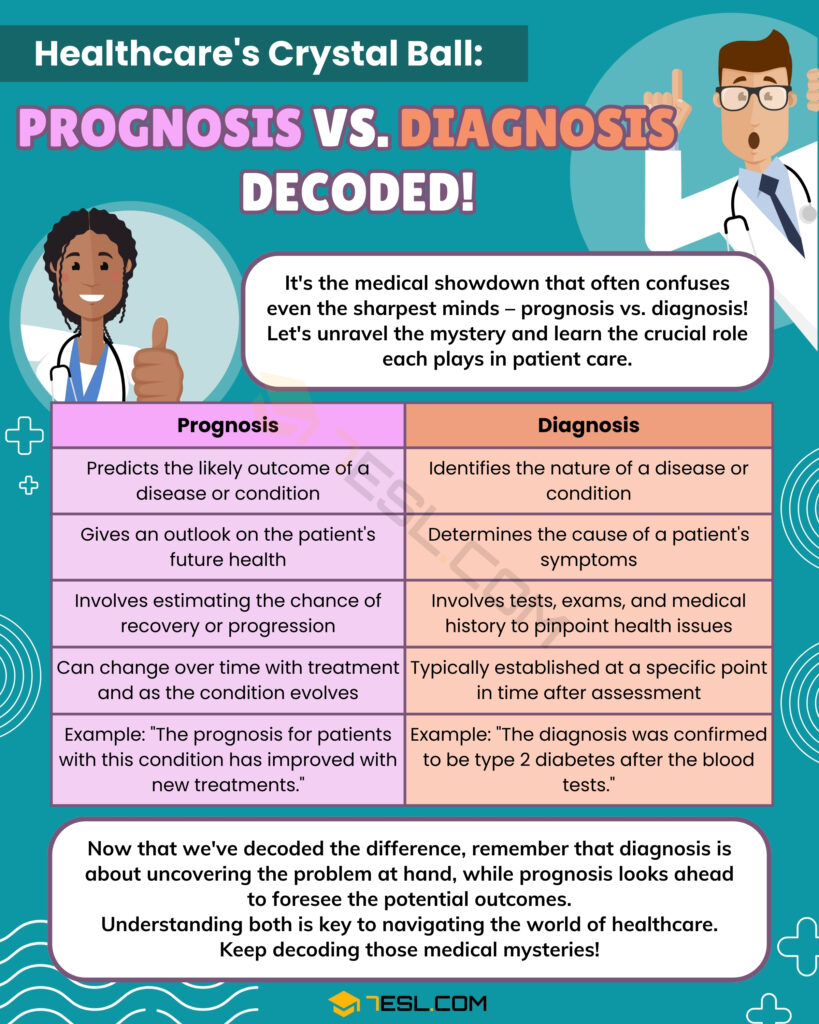
Diagnosis and prognosis are linked, but they are not the same. The diagnosis tells the reader what condition is present. Prognosis explains what is likely to happen next and why.
For example, a claimant may have sustained a soft tissue injury to the neck. That diagnosis alone does not answer how long symptoms should last. The prognosis depends on severity, early symptoms, treatment, recovery pattern, previous history, psychological factors, work demands and current examination findings.
The same applies to psychological injury, chronic pain, mild traumatic brain injury and aggravation of degenerative conditions and the expert should explain how the diagnosis informs expected recovery, but they should not treat diagnosis as a shortcut to prognosis.
The starting point is the clinical course so far.
Prognosis should be based on the claimant’s actual recovery pattern.
Has the claimant improved? If so, when and to what extent? Are symptoms stable, fluctuating or worsening? Has there been treatment? Did treatment help? Has the claimant returned to work? Are daily activities improving? Are there ongoing restrictions? Is medication still needed? These details matter.
A claimant who has steadily improved over three months presents a different prognosis from a claimant whose symptoms have remained unchanged for a year. A claimant who has not accessed treatment may have a different outlook from one who has completed rehabilitation without improvement.
The expert should not impose a standard recovery period without looking at the course so far and prognosis must be individualised.
The report should distinguish accident-related recovery from background symptoms.
This is especially important where there are pre-existing conditions.
A claimant may have had back pain, neck pain, anxiety, depression, osteoarthritis or degenerative spinal changes before the accident. The accident may have caused a new injury, aggravated a previous condition or temporarily worsened an underlying problem.
The prognosis section should find what is accident related.
If the expert considers that the accident caused a six-month aggravation of a pre-existing condition, that should be clear. If the claimant’s ongoing symptoms are more likely due to natural degeneration, that should be explained. If the accident accelerated symptoms that would have occurred later, the report should say so. This prevents the prognosis from becoming too broad.
The court needs to know how long the accident-related element is likely to last, not merely how long the claimant may continue to have symptoms from any cause.
Current symptoms should be linked to function.
A good prognosis section should deal with function, not only pain or diagnosis.
Can the claimant work? Can they drive? Can they perform domestic tasks? Can they care for dependants? Can they sleep properly? Can they exercise? Can they travel? Are they restricted in hobbies or social life?
Function gives prognosis practical meaning.
A claimant may continue to have mild pain but no meaningful restriction. Another may have moderate symptoms that prevent return to manual work. A third may have psychological symptoms that interfere with travel, rehabilitation or employment.
The expert should explain whether ongoing symptoms are likely to affect daily life and for how long.
A prognosis that says “symptoms may continue for three months” is less useful than one that explains what the claimant is likely to be able to do during that period.
Treatment and rehabilitation should be addressed.
The prognosis section should include treatment where it may affect recovery.
Is further physiotherapy reasonable? Is pain management needed? Should the claimant continue home exercises? Is psychological therapy shown? Is occupational therapy needed? Is a medication review, right? Would a phased return to work assist? Is further specialist evidence needed?
The expert should be careful not to recommend treatment outside their expertise.
An orthopaedic expert may properly comment on physiotherapy or musculoskeletal rehabilitation. They should be cautious about detailed psychological therapy recommendations unless qualified to make them. A psychiatrist or psychologist may be better placed to address psychological treatment needs. A pain specialist may be needed in persistent pain cases.
Where further treatment is recommended, the report should explain why it is reasonable and what effect it may have on prognosis.
Treatment should not be added as an afterthought.
The expert should explain delayed recovery.
Delayed recovery requires analysis.
If the claimant has not recovered within the expected period, the report should consider why. Explanations may include injury severity, pre-existing vulnerability, chronic pain development, psychological distress, poor sleep, fear avoidance, delayed rehabilitation, physically demanding work, treatment non-engagement or unrelated health problems.
The expert should not automatically assume that delayed recovery proves an ongoing accident-related injury. Nor should they dismiss it simply because recovery has taken longer than average.
The question is whether the delayed recovery is medically plausible and whether it remains related to the accident.
Where the evidence is mixed, the prognosis should be qualified.
Prognosis should not ignore psychological factors.
Psychological symptoms can affect recovery even where the original injury was physical.
Anxiety, low mood, pain-related distress, travel fear, loss of confidence, poor sleep and fear of movement may all prolong symptoms or reduce function. In some claims, psychological factors become more important than the original physical injury.
A prognosis section should show this where relevant.
If psychological symptoms are mild and improving, they may not require separate expert evidence. If they are significant, persistent or central to disability, further psychiatric or psychological evidence may be needed.
The expert should not treat psychological symptoms as irrelevant simply because the instruction is for a physical injury report. Equally, they should not diagnose beyond their competence, and the correct approach is to record the issue, explain its effect on recovery and recommend further evidence if necessary.
Uncertainty should be stated clearly.
Prognosis is rarely certain.
The expert should make clear where the opinion is firm and where it depends on future events. Recovery may depend on treatment engagement, further investigations, surgery, psychological therapy, return-to-work support or the natural course of a pre-existing condition.
It is better to say this clearly than to give false precision.
For example, an expert may say that symptoms would usually be expected to resolve within a further three to six months, provided the claimant engages with rehabilitation and no new pathology is shown. That is more useful than a fixed date without explanation.
Where the evidence is incomplete, the prognosis should say so.
Missing records, absent imaging, incomplete treatment notes or lack of occupational evidence may all limit the opinion. The prognosis should reflect those limits.
The prognosis period should be justified.
If the expert gives a recovery period, they should explain the basis for it.
Why three months? Why six months? Why two years? Why permanent symptoms? The reader should be able to see how the period has been reached.
This does not require an overlong explanation in every case. In a straightforward injury claim, a short, reasoned paragraph may be enough. In a complex case, more detail is needed.
The expert should consider the mechanism of injury, clinical findings, records, treatment history, pre-existing conditions, current function and expected course.
Further evidence may be needed.
A prognosis section should identify when the expert cannot safely give a final opinion.
Further evidence may be required where symptoms are persistent, unexplained, complex or outside the expert’s field. This may include imaging, pain specialist evidence, neurological assessment, psychiatric or psychological evidence, occupational health records, employment records, rehabilitation reports or updated medical records.
The expert should be specific.
It is not enough to say, “further evidence may assist.” The report should explain what evidence is needed and what question it may answer.
For example, updated GP records may clarify whether symptoms are improving. Physiotherapy notes may show treatment response. Occupational records may clarify work capacity. Psychiatric evidence may address whether ongoing avoidance is due to accident-related anxiety. Targeted recommendations are more useful than general caution.
Permanent symptoms require particular care.
If the expert considers that symptoms are permanent, the reasoning must be strong.
Permanent prognosis should not be used casually. It has significant consequences for valuation and future loss. The expert should explain why further recovery is unlikely, what treatment has already been tried, whether symptoms have stabilised, whether any further intervention may help and whether ongoing symptoms are accident related.
Where pre-existing degeneration or vulnerability is present, the expert must separate accident-related permanence from natural progression.
A claimant may have permanent symptoms, but not all of them may be caused by the accident.
That distinction should be clear.
A strong prognosis section answers the practical questions.
The best prognosis sections answer the questions the parties need.
How long are accident-related symptoms likely to last? What recovery has already occurred? What symptoms are likely to remain? What function is likely to improve? Is treatment needed? Is further expert evidence required? What part of the presentation is accident-related? What part may be pre-existing or unrelated? What assumptions has the expert made? What uncertainty remains?
Those questions are practical.
They are also the questions that often decide settlement.
A prognosis section should not be a standard paragraph attached to the end of the report. It should be the reasoned endpoint of the medical analysis.
The expert’s role.
The expert does not have to predict the future with certainty.
They must give a balanced, evidence-based opinion on recovery.
That means explaining the clinical course, considering the records, addressing baseline, analysing treatment, identifying functional impact, recognising uncertainty and staying within expertise.
A good prognosis section is measured, specific and useful.
It tells the parties not only when the claimant may recover, but why that period is reasonable, what could change it, and what part of the symptoms can properly be linked to the accident.
That is what makes prognosis evidence credible.